
Jump to:
There’s just something mesmerizing about wagara (和柄), or traditional Japanese patterns. Some are inspired by nature, while others come from geometric shapes, traditional objects, or centuries-old cultural traditions.
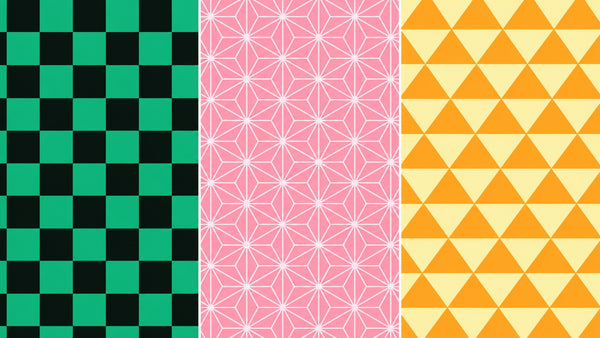
These patterns have also found a modern representation in popular culture, including anime. If you’re familiar with Kimetsu no Yaiba (Demon Slayer), you may have already noticed some traditional Japanese patterns in the characters’ clothing. Tanjiro, for example, wears the distinctive ichimatsu checkered pattern on his haori, while Nezuko’s kimono features the beautiful pink asanoha hemp-leaf pattern. Zenitsu is also recognizable by the uroko scale pattern on his yellow-orange haori.
But these patterns are more than just beautiful designs. Many have their own symbolism, representing wishes for good fortune, longevity, happiness, protection, prosperity, and more.
In this guide, let’s take a closer look at the origins and inspirations behind Japanese patterns, explore some of the most popular traditional patterns and designs, and discover the meanings behind them.
Hopefully, once you know a little more about them, you’ll start noticing these beautiful patterns in a whole new way!
Japanese Patterns Brief History
Before we dive into the individual patterns, where did Japanese patterns begin?
According to Fuji Eriko, a researcher of Japanese patterns interviewed by Highlighting Japan, the history of Japanese patterns can be traced back to the Jōmon period, more than 10,000 years ago. Early pottery was decorated with simple patterns made using fingernails, shells, ropes, and other objects. Some designs featured curved lines and waves, geometric shapes, and impressions made from ropes.

Photo: A Jōmon-period pottery vessel with patterns thought to represent flowing water (Collection of Kyushu National Museum)
Japanese patterns continued to evolve through cultural exchange. During the Kofun period (late 3rd to 7th century), designs from China and other regions reached Japan, while Buddhist motifs such as the lotus flower became part of Japanese art and architecture.
By the Heian period (late 8th to late 12th century), many imported designs had been adapted to Japanese tastes. This period also saw the development of yūsoku monyō (有職文様), traditional patterns associated with the customs and formal culture of the imperial court. These patterns were used on kimono, lacquerware, ceramics, furnishings, and other objects.

Photo: Yūsoku monyō (有職文様), traditional court patterns.
Nature also became one of the biggest sources of inspiration. Flowers, plants, birds, insects, waves, mountains, and other elements of the natural world were turned into decorative patterns.
Traditional Japanese Patterns & Their Meanings
Now that we’ve explored where Japanese patterns came from, let’s take a closer look at some of the most recognizable wagara you may come across today, plus the stories and meanings behind them.
1. Seigaiha (青海波) Japanese Wave Pattern ![]()
 One of the best-known traditional Japanese patterns is seigaiha, meaning "blue ocean waves." The design consists of overlapping semicircles that resemble waves spreading across the sea. The repeating waves are often associated with peacefulness and good fortune.
 Fuji Eriko explains that the repeating waves can represent a wish for eternal happiness in the future. Because the waves continue across the pattern without an obvious beginning or end, seigaiha expresses the idea of continuing happiness.
This is an example of the seigaiha pattern on a traditional Japanese sensu (folding fan).
2. Asanoha (麻の葉) Hemp Leaves Pattern

Asanoha is a striking geometric pattern based on the shape of hemp leaves. Its repeated six-pointed forms create a star-like design.
Hemp was valued for its vigorous growth and the plant can grow strongly without extensive care. Because of this association with vitality, asanoha was traditionally used on clothing for babies and children with the hope that they would grow up big and strong.
Here's an example of the asanoha pattern on a traditional Japanese wooden bento box.
3. Yagasuri and Yabane (矢羽根) Arrow Feather Pattern

Yagasuri, also called yabane, is based on the feathers attached to arrows. Because an arrow travels toward its target and does not return once released, the motif developed an auspicious association with moving forward.
Nippon.com notes that during the Edo period (1603–1868), brides were given kimono featuring yabane as a good-luck motif. The design later became strongly associated with graduation clothing, particularly when worn with hakama.
4. Kikkō (亀甲) Tortoiseshell Japanese Pattern

Kikkō is a geometric pattern made from repeating hexagons inspired by a tortoise shell. The tortoise has traditionally been associated with longevity.
Different variations can combine the hexagonal structure with smaller hexagons, flowers, or other motifs.
5. Shippō (七宝) Seven Treasures Pattern

Shippō is created from overlapping circles. Where the circles intersect, they form shapes resembling petals and stars. The pattern is considered auspicious, symbolizing prosperity, harmony, good relationships, and continued prosperity for future generations.
6. Ichimatsu (市松模様) Japanese Checkered Pattern

Ichimatsu is a classic checkered design consisting of alternating squares.
Although checkered patterns existed in Japan before the name became established, Nippon.com explains that ichimatsu became associated with the eighteenth-century kabuki actor Sanogawa Ichimatsu, who was known for wearing the pattern on his hakama.
The design has continued to appear in modern Japanese culture. It became especially recognizable through the green-and-black haori worn by Tanjirō in Demon Slayer: Kimetsu no Yaiba and was also incorporated into the logos for the 2020 Tokyo Olympic and Paralympic Games.
7. Karakusa (唐草文様): Scrolling Vine Pattern

Karakusa is a scrolling vine pattern in which plant stems wind and extend across the surface. Its spreading vines symbolize longevity and prosperity.
The design became particularly associated with furoshiki, the square Japanese cloth traditionally used for wrapping and carrying objects.
8. Uroko (鱗) Scales Pattern

Uroko means “scales” and consists of repeated triangles resembling the scales of fish or snakes. The pattern was traditionally associated with protection, and samurai wore garments featuring uroko as a talisman to ward off harm.
Its bold geometric design also makes it easy to recognize among softer floral and wave motifs.
You may also recognize this pattern from Zenitsu’s yellow-orange haori in Demon Slayer!
More Than Just Beautiful Designs
Japanese patterns are more than just decorative designs. Behind many of these repeating waves, leaves, flowers, and geometric shapes is a story, a tradition, or a wish for something good.
You can still spot traditional wagara on kimono, ceramics, textiles, packaging, architecture, family crests, and other everyday objects.
So, the next time you come across a Japanese pattern, take a moment to look a little closer. The design might reveal a wish for longevity, protection, happiness, prosperity, or simply a connection to nature and Japanese tradition. Once you know the stories behind them, these familiar patterns can take on a whole new meaning.


0 댓글